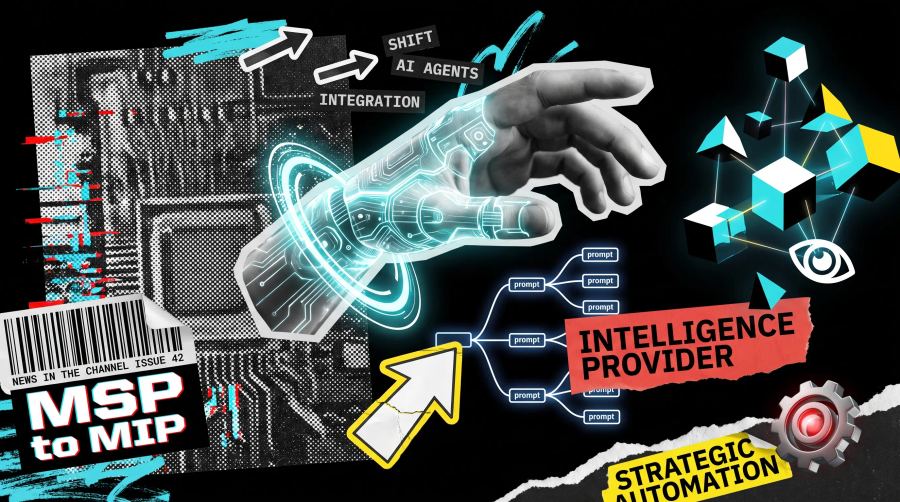
Inflection Point is featured in issue 42 of News in the Channel. Iain Godding on why the managed service provider is becoming a managed intelligence provider, why the service desk will shrink, and what that changes if you are the one buying IT.
The IT provider you buy from today will be selling something different in three years' time. That's the argument Iain Godding, our managing director, makes in the latest issue of News in the Channel, where Inflection Point is the subject of a feature titled "Point of difference". You can read the fll feature in issue 42.
The short version: routine support work is being absorbed by AI agents built into the operating system, and the providers who stay useful will be the ones doing strategic and development work instead. The trade press has a name for the result. A managed intelligence provider, or MIP.
We think that shift matters more to the businesses buying IT than it does to the businesses selling it, so this post unpacks what Iain said and what it means if you're the person signing the contract.
What is a managed intelligence provider (MIP)?
A managed intelligence provider is an MSP whose main output is applied intelligence rather than ticket resolution: building automations, wiring AI into existing business systems, and advising on where technology should take the business next. The term isn't a standard or a certification. It's shorthand the channel has started using for a real change in what clients are paying for.
Iain puts our position in it plainly. "Within the MSP space, there's talk of MIPs, or managed intelligence providers, and the pivot that mid-market MSPs like Inflection Point are doing is driving in that direction. We've got a good position on that with the investments we've made in development and software."
The practical difference is who's in the room. A traditional MSP sends you an engineer when something breaks. A provider working this way sends you someone who has read your process, understands where the time goes, and can build something that removes the work. We do the first thing too, through managed IT services and a proper helpdesk. The second is where the value is going.
Why the service desk is going to shrink
Because the operating system is about to do a large share of that work itself. This is the most uncomfortable prediction in the feature, and Iain makes it about his own business rather than someone else's.
"I'm acutely aware that AI is coming, and the day will come where there's a Copilot agent on Windows devices that can do most of the stuff that technicians do at the moment," he says. "That sort of service desk element is going to reduce, which is where the consultative strategic vision, helping businesses drive forward, is important. And that's where we're pivoting to."
If you want to see how far along that road Microsoft already is, Microsoft 365 Copilot is the visible end of it, and we've written separately about what agentic tools like Microsoft Scout mean for your business. The direction of travel is clear enough that any IT provider claiming their support model is safe for the next decade is either being optimistic or hasn't looked.
For you as a buyer, this changes what you should be testing on a shortlist. Response times still matter, and ours are published. But a provider whose entire proposition is speed of ticket resolution is selling you the part of the service that's about to get cheaper.
Where most SMEs actually get stuck with AI
Not at the start. At the join. Iain describes a split among the businesses we talk to, and neither group is where the marketing assumes they are.
"Some have used ChatGPT or Claude and they're unimpressed, and closed the lid on AI," he says. "But others have done more work, perhaps they've got AI doing elements of their marketing or finance and they get so far and then run out of talent internally and need somebody who can tie different systems together."
That second group is the interesting one, and it's where being an MSP turns out to be an advantage. We already hold the map. "We know how the telephony works, how the finance system works, how all the server infrastructure is put together," Iain says, "so ... we can quickly and easily pull all that together. We know where to point it and we can help unblock the projects that they're running internally, or they can just give it to us and say, 'give me the outcome, I want it to do X, Y, Z'."
Very few AI projects in a 50 to 300 person business fail because the model isn't clever enough. They stall because the data sits in four systems that don't talk to each other, or because nobody internally has time to own the integration. That's an infrastructure problem wearing an AI hat, which is why our AI consultancy and business process automation work usually starts with plumbing rather than prompts. If you're earlier in the journey, our guide to what AI actually works for SMEs is a better starting point.
What UK businesses are actually buying right now
Cloud migrations and security, in volume. The feature is candid that the cutting edge is only half the picture, and the other half is the unglamorous work that keeps businesses running.
"In this last 12 months we've probably done more SharePoint migrations than we've done before," Iain says. "Customers are embracing it now. Servers are reaching end of life for some customers, so it's the natural move for them to fully embrace the cloud."
That end-of-life wave is a genuine trigger point. When the box in the cupboard reaches the end of its supported life, you get a rare window to redesign how the business works instead of buying the same thing again. Microsoft SharePoint is where a lot of those file servers end up, and we've written a fuller guide to SharePoint's features and business benefits. The cloud enablement work sits alongside it.
On security, Iain's emphasis is on education before technology. "A lot of it is about education, making sure that customers know not to engage with a suspicious-looking email," he says. "We are ISO 27001, so we share those policies with customers and say, if someone deals with you on email and they ask you to change your bank account, make sure you speak to the person at that business you know before you do that. Don't just action it over email. Something as simple as that can save businesses tens of thousands of pounds."
Invoice redirection fraud is still one of the cheapest attacks to run and one of the most expensive to suffer, and the control that stops it is a phone call, not a product. The technology sits behind that. "We've also got 24/7 SOC and things like that in place so that our on-call engineers get notified if something untoward happens on a customer site," Iain says. "We partner with Huntress and SentinelOne and use a lot of Microsoft stack in our security posture." You can read more about how we approach cyber protection and compliance, or about the SentinelOne Singularity platform specifically.
Why an IT provider's structure should matter to you
Because it decides how quickly anyone can say yes to you. Iain is direct about how Inflection Point is set up and why.
"There's no private investment, it's one person at the top, and I can make the choices and changes," he says. "We can be very agile and come up with clever things for our customers quickly that some bigger MSPs or MSPs that are grouped together through private equity just can't do."
Two things follow from that which you can check on any provider. The first is whether the people advising you are paid to sell. "Our account managers are technical, they used to be engineers or service desk folks, so they understand what we're doing, and they don't have targets or quotas, it's about what is the best thing for the client," Iain says. The second is whether the business has a mechanism for trying things and stopping them. We run on EOS, the Entrepreneurial Operating System, which gives us a quarterly rhythm for exactly that, and we've written about what adopting EOS changed internally.
Paired with it is a rule Iain calls fail fast. "We're happy to try something, put some money into a proof of concept, but if it doesn't work, then we fail fast and move on to the next thing. You need the space to have the trial and error." A provider without that space will keep selling you last year's answer.
What this means for you
If you're responsible for IT in a growing business, the shift described in the feature changes a handful of practical decisions.
- Ask your provider what happens to their service desk. Anyone who hasn't thought about it hasn't thought about the next contract term either.
- Buy the integration, not the model. Your AI project will succeed or fail on whether your systems can talk to each other. Start there.
- Treat an end-of-life server as a design decision. It's the cheapest moment you'll get to change how the business works.
- Check who advises you and how they're paid. Quota-carrying account management and honest technical advice pull in different directions.
- Ask what they've stopped doing. A provider that has never killed a project isn't experimenting.
Iain ends the feature on the goal we've set ourselves. "Our core goal is that we set ourselves is to become the most referred MSP in the UK. If our clients are referring us to other businesses, it means that we're doing a good job for them and we're servicing their needs. It's about having a business that does the right thing for clients, and our clients want to recommend us and promote us online. That says more to me than hitting a £10 million revenue target or whatever it might be."
Thank you to News in the Channel for the feature. If any of the above sounds like the conversation you need to have about your own IT, you're welcome to book a Discovery Call with Iain. If you'd rather work out the shape of the problem first, our note on choosing between in-house, outsourced and co-managed IT is a good place to start.